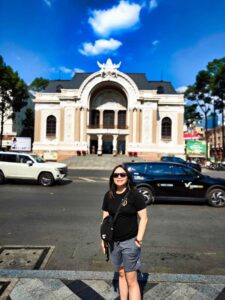
My name is Linda Diệp, and I am the founder of Triều Đại Coffee. I was born in Saigon, Vietnam, and came to the United States with my family as part of the Vietnamese refugee diaspora. Like many Vietnamese Americans, I grew up with two places shaping my identity at once. Vietnam was where my story began, while the United States became the place where I grew up, built my career, and eventually started a business. Triều Đại Coffee grew out of my desire to connect those two worlds while changing the way people understand Vietnamese coffee.
For decades, Vietnam has been one of the largest coffee-producing countries in the world. Yet here in the United States, Vietnamese coffee is still often reduced to a preparation style: strong coffee, condensed milk, and a phin. I love Vietnamese coffee (cà phê sữa đá). It is part of our culture and our history, but Vietnamese coffee is so much bigger than that. Behind every cup is an agricultural story. There are farmers, producers, processors, roasters, distinct growing regions, different elevations, varietals, processing methods, and generations of knowledge. Vietnam is capable of producing exceptional Arabica, Fine Robusta, and specialty coffees with complexity that many American consumers have never had the opportunity to experience. I created Triều Đại Coffee because I want those coffees to be experienced on their own terms.
What Does “Triều Đại” Mean?
Triều Đại is Vietnamese for dynasty, and the name was chosen intentionally. A dynasty is something that extends beyond one person. It represents generations, inheritance, history, and what is carried forward from one era into the next. That idea is at the heart of what I want Triều Đại Coffee to represent.
Vietnamese coffee did not suddenly become worthy of attention because the specialty coffee industry discovered it. Vietnam already had generations of farmers growing coffee, families building livelihoods around it, and producers developing knowledge specific to their land. What is changing is the opportunity for the rest of the world to finally experience what they are capable of producing. To me, Triều Đại is about honoring what came before us while helping build what comes next.
How to Pronounce Triều Đại
Vietnamese is a tonal language, so there is no perfect English phonetic equivalent for Triều Đại. For English speakers, a helpful approximation is Triều, roughly “tree-uh,” spoken together as one syllable, and Đại, roughly “die,” with a heavier, lower tone.
The Vietnamese letter Đ is pronounced like an English D. It is different from the Vietnamese letter D, particularly in the southern Vietnamese pronunciation I grew up speaking. You do not have to pronounce Triều Đại perfectly to drink our coffee, but I want people to know the name because the language and identity behind it are part of the story.
Why I Started Triều Đại Coffee
When I began learning more deeply about Vietnam’s specialty coffee industry, I realized there was an enormous gap between what was being produced there and what American consumers understood Vietnamese coffee to be. I met producers whose coffees challenged nearly every stereotype I had heard about Vietnamese coffee. These were carefully cultivated and processed coffees with floral aromatics, fruit-forward profiles, natural sweetness, clean finishes, and remarkable complexity. I encountered Arabica varieties and Fine Robusta that deserved to be evaluated with the same seriousness afforded to specialty coffees from better-known origins.
I kept coming back to one question: Why aren’t more people in the United States tasting this? That question eventually became Triều Đại Coffee.
Our Mission
Our mission is to bring exceptional Vietnamese specialty coffee to the United States while preserving the value, craftsmanship, and identity of its origin. That means our relationship with Vietnam does not end when coffee leaves the farm. We intentionally work with Vietnamese producers and partners so that the expertise and value created through cultivation, processing, drying, and roasting remain connected to Vietnam. Rather than treating Vietnam simply as a source of raw agricultural material, we want the finished coffee to tell a much more complete story about where it came from and who created it.
The coffees we represent come from producers who are pushing Vietnamese specialty coffee forward, including award-winning farms and lots evaluated at specialty-grade scores. But scores and awards are only part of the story. What matters most to me is what happens when someone tastes one of these coffees without preconceived ideas about what Vietnamese coffee is supposed to taste like.
I want someone to taste a beautifully processed Vietnamese Arabica and discover florals, stone fruit, citrus, chocolate, or honey. I want someone who thinks they dislike Robusta to taste a clean, carefully processed Fine Robusta and stop for a second because it tastes nothing like what they expected. That moment of surprise is important because it means the old narrative is beginning to change.
Vietnamese Coffee Does Not Need to Imitate Anyone Else
My goal is not to prove that Vietnamese coffee can taste like Ethiopian coffee, Colombian coffee, or coffee from any other respected origin. Vietnam does not need to become another origin to earn a place in specialty coffee. It needs the opportunity to show what Vietnamese coffee can be.
That includes celebrating Arabica grown in places like Đà Lạt and the highlands of Lâm Đồng, while recognizing the enormous potential of carefully cultivated and processed Robusta from the Central Highlands. It means talking about varietal, terroir, processing, elevation, fermentation, roasting, and craftsmanship with the same vocabulary and seriousness routinely given to other coffee-producing countries. It also means giving the people producing these coffees visibility.
When I talk about our coffee, I want you to know where it came from. I want you to know the producer and understand why a particular lot tastes the way it does, because origin should mean more than a country printed on the back of a bag.
Building a New Chapter
Triều Đại Coffee is still young. I am building it while learning, traveling, meeting producers, introducing coffees to people one cup at a time, and figuring out how to create a lasting bridge between Vietnam’s evolving specialty coffee industry and the American market. There is something deeply personal about doing this work as someone who was born in Vietnam and grew up in the United States.
I get to return to the country where my story began and encounter it differently as an adult. I get to speak directly with Vietnamese farmers and producers in our own language, listen to their stories, understand what they are trying to accomplish, and then bring those stories back with me. In many ways, Triều Đại Coffee exists between two worlds, just as I do, and perhaps that is exactly where it belongs.
I want Triều Đại to help create a future where seeing Vietnam on a specialty coffee bag tells you something about quality before you ever take the first sip. A future where Vietnamese coffee is not treated as a novelty or confined to a single preparation method. A future where Vietnamese farmers and producers are recognized not simply for how much coffee their country grows, but for how extraordinary that coffee can be.
That is the dynasty I want to help build.
Welcome to Triều Đại Coffee.